Could you provide an overview of Sitechecker?
We primarily focus on monitoring website server performance and real-time data, trying to integrate data from Google Search Console, Google Analytics, and our tools like Site Audit Tracker. Our main competitors are Semrush and Ahrefs. Our customers love us because of our simple & great design and some features like comprehensive site audit and site monitoring.
We built it three or four years ago, and it started off like a small tool, a one-feature tool. It was called the On-page SEO checker. We checked the online page for technical SEO issues, and then, step by step, we started trying new features and adding them. We also use SEO, the main traffic channel, and we have many landing pages. Since we know how to do SEO, we try to help our customers to do that properly too.
So, right now our team is around 20-25 people, half of the team takes care of the product and marketing, and the rest of them take care of the engineering aspect.
What challenges were you experiencing that led you to look for a solution like Nolt?
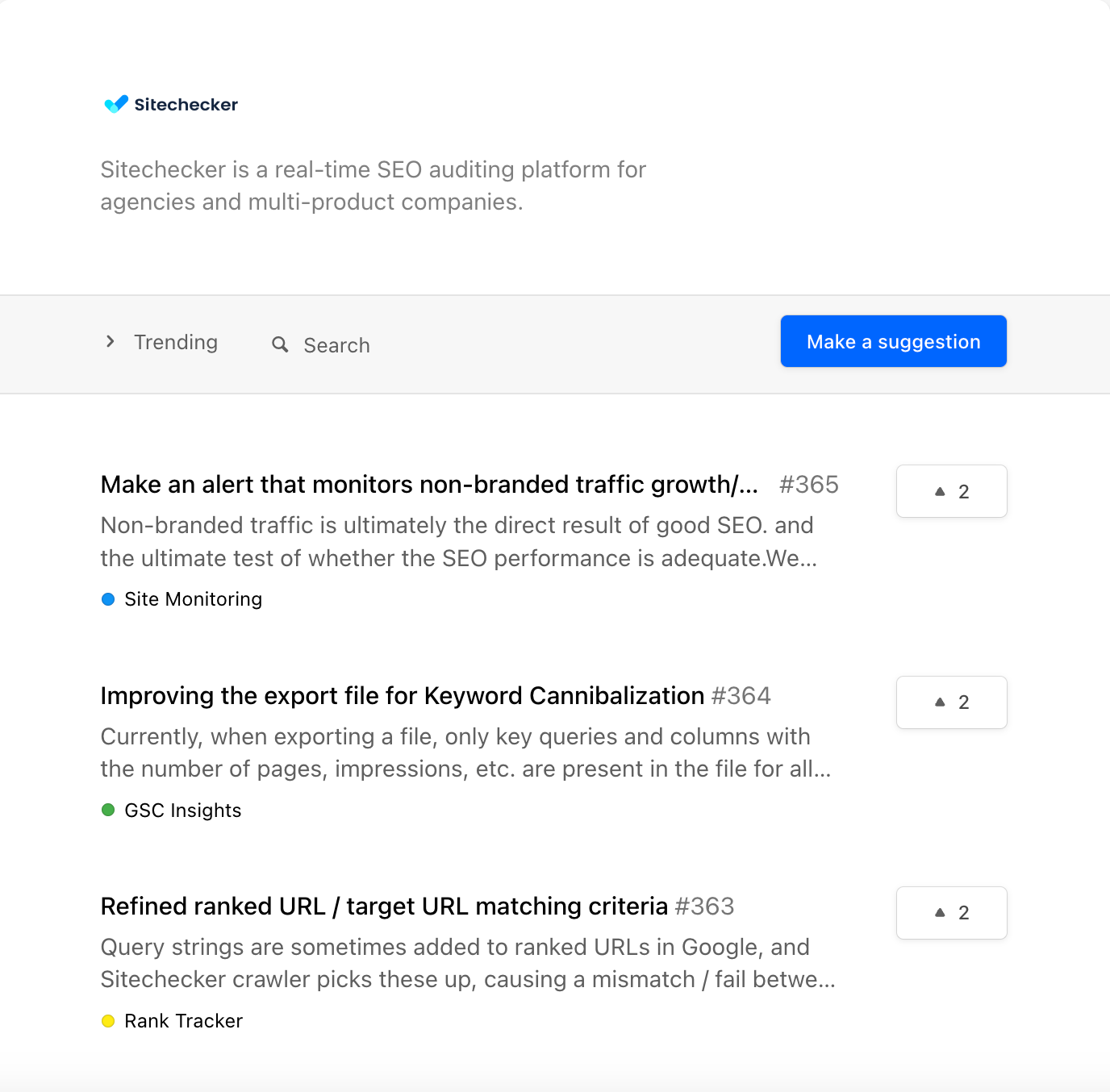
One of the challenges was to collect all user requests, address them, and have them in one place. I used different polls in Typeform and in other places, and they were placed in Google Sheets and so on. We would like to place them in one place, that is the first thing. The other thing is, when the user understands that he wants some feature, it is much easier for him to vote for that feature or add it as a request, and when users like the roadmap, they can help us understand what they are really interested in, and it is very easy for them because voting is made much easier with the added account.
Right now, what’s actually important is that I can notify the users who commented on a feature request or upvoted it, and it helps me a lot because I get quick feedback from the users when I update that feature, saying that it’s completed, and I get to see the comments on it from the user as well. I also don't have to manually find the email of the user who requested that feature; it’s already built into the roadmap.
When I was looking for a solution, I compared Canny because I saw that other competitors do that. What I found was that it was both highly priced and looked difficult to use. I found that Nolt is used by another product from Ukraine, so I just quickly tried to create a board, and when I found that it is very useful to manage, to add things for both the users and me, which is why I decided to go for it.
The first year was difficult. The main problem is that when you have fewer features and too few audience that visit the page, and you see that nobody is voting for things, and you don’t see any activity, you lose motivation, but then we started trying to send more traffic from the website, from the e-mail newsletter to the page. I also found it useful for me that whenever any new feature idea came to me, I went to the roadmap and added it, even if it was visible just to me. It helps me remember, it’s like my personal space where I store all my ideas too.
What benefits have you and your team gotten from implementing Nolt at Sitechecker?
The first one was prioritization, and it’s the most important one, you know what users requested the most. When I see a comment and if the user is not anonymous i.e. i can see the name of the customer, or when they write a long comment, when they put in a feature request, I understand that they are usually a paid customer and they are ready to invest in improving our app.
Then, user activation into new features – they know when the new feature is implemented. We try to announce the news everywhere on social media and email newsletter, but it’s often the case that some users can miss that. So that’s why we are interested in one more channel to send notifications about some new feature implementations.
Yeah, not only prioritization, even knowing what the user requested because we do user interviews, we do polls, sometimes users write something to the customer support, but when they learn there exists a place where they can go and add feature requests, they can check the roadmap, what was done, and what’s in progress. It’s like a feature for them to understand how the product evolves.
How do you guys use Nolt at your business? What does it look like? What's the workflow?
It’s primarily me; I am the product manager. First, I add my ideas to Nolt, and then when the user requests some feature, and if I am already trying to create this feature, I will send them the link from Nolt to this feature request and get their vote. So, I am trying to force users to take part in filling the roadmap.
The second step, we implemented the link to Nolt in our app’s help section, linking it to the roadmap, and when a customer clicks on that, they are quickly redirected to the roadmap. We try to have banners and email newsletters to acquire customers to this page.
So you mentioned you are the product manager. How do the developers get involved with the process in general?
I create a task for the designers and developers, and I will attach the link to the feature request in Nolt just to explain what the users request looks like so they that they can read what customers have requested and its proof for me that this is really important for our customers, which means it is also important our developers know that they create what people want.
Before using Nolt and after using Nolt, what improvements have you seen?
So, again, the first thing is prioritization, we make better decisions, and it has a direct influence on our growth rate. We made many mistakes in developing our own features that nobody wants. If you rely solely on user interviews, it’s really difficult to always get users to be involved in interviews because it expends their time.
This roadmap, it helps them to quickly help you in developing the app because they spend a few seconds or a minute, and that’s it.
If you had to describe Nolt in one sentence, what would it be?
The place where users know what’s going on in your product and can impact that.