Could you provide a quick overview of Nested Knowledge and who you serve?
Nested Knowledge is a software company that provides a product to clinical researchers to enable the collection, analysis, and presentation of published data.
We generate 95% of our revenues from B2B but in terms of users, the majority of them are academics, so we’re consumer-facing at the same time. Nolt is a nice part of serving both of those customer bases.
What challenges led you to look for a solution like Nolt?
We needed more customer feedback. At the very beginning of my tenure at Nested Knowledge, I came on as the design guy. I’m UX/UI but ended up doing some of the marketing – that’s how it goes in a startup, right?
We needed more user feedback. We had only one customer who was actually paying us at the time we adopted Nolt, and they were our only source of feedback, so everything was viewed through their lens.
We weren’t sure if this was the right workflow for that customer, or is this the right workflow for our user base, so we needed to figure out a way to get more feedback in relatively short order in order to make sure we had the right product-market-fit.
We were looking around for tools, and we really liked how lightweight Nolt felt to us. It was purely for gathering product feedback, whereas a lot of the other competitors seemed to do too many things at once.
We felt Nolt was going to allow us to do exactly what we set out to do, which is gather that feedback and present a way for our users to interact with us that was separate from Gitlab but also could be integrated with Gitlab, which we liked.
What benefits have you and the team gotten from using Nolt?
I think we feel closer to our customers – that’s the number one thing.
As soon as we got our first feature request via Nolt, we immediately saw the benefit in terms of feeling close to our customers. Our customers feel closer to our product, and we feel closer to our customers.
It was in the middle of the pandemic that we adopted Nolt, so there was no such thing as an in-person user interview in 2020. It just didn’t happen, and we also didn’t have the budget for it anyway.
We needed to move so quickly that it was important to gather user feedback in a really lightweight platform like Nolt, so we can get that iterative process and feedback.
Feeling closer to the customers’ requests is the number one thing that Nolt has provided for us.
What are the problems that Nolt solves for you and your team?
It allows us to interact in real-time with our user base. When people have a support request, it can come in through email, but that’s a bit of a headache since we have to create an issue.
Nolt is nice because the community can create issues. We can interact with those issues, we can comment on them, and internally, we can mark it with a certain priority. If it’s a really good idea but we’re not sure how it’s going to fit in yet and we just want a bit more feedback on that idea, Nolt lets us do that. It can sit in Nolt until it is time to actually move it over to Gitlab and give it a true priority to send it through our design and development cycle.
How did you find the setup process?
Super easy! That was the other thing that made me adopt it on day one, and our team was really small back then. I literally just emailed three people and said we should go with Nolt because it was so easy to set up. I can add my branding to it, link to it, embed it – all that was very easy. I think it took me probably 20 minutes for our initial Nolt installation, and it just went right onto our marketing website, and we were good to go.
Which feature do you find yourself using most?
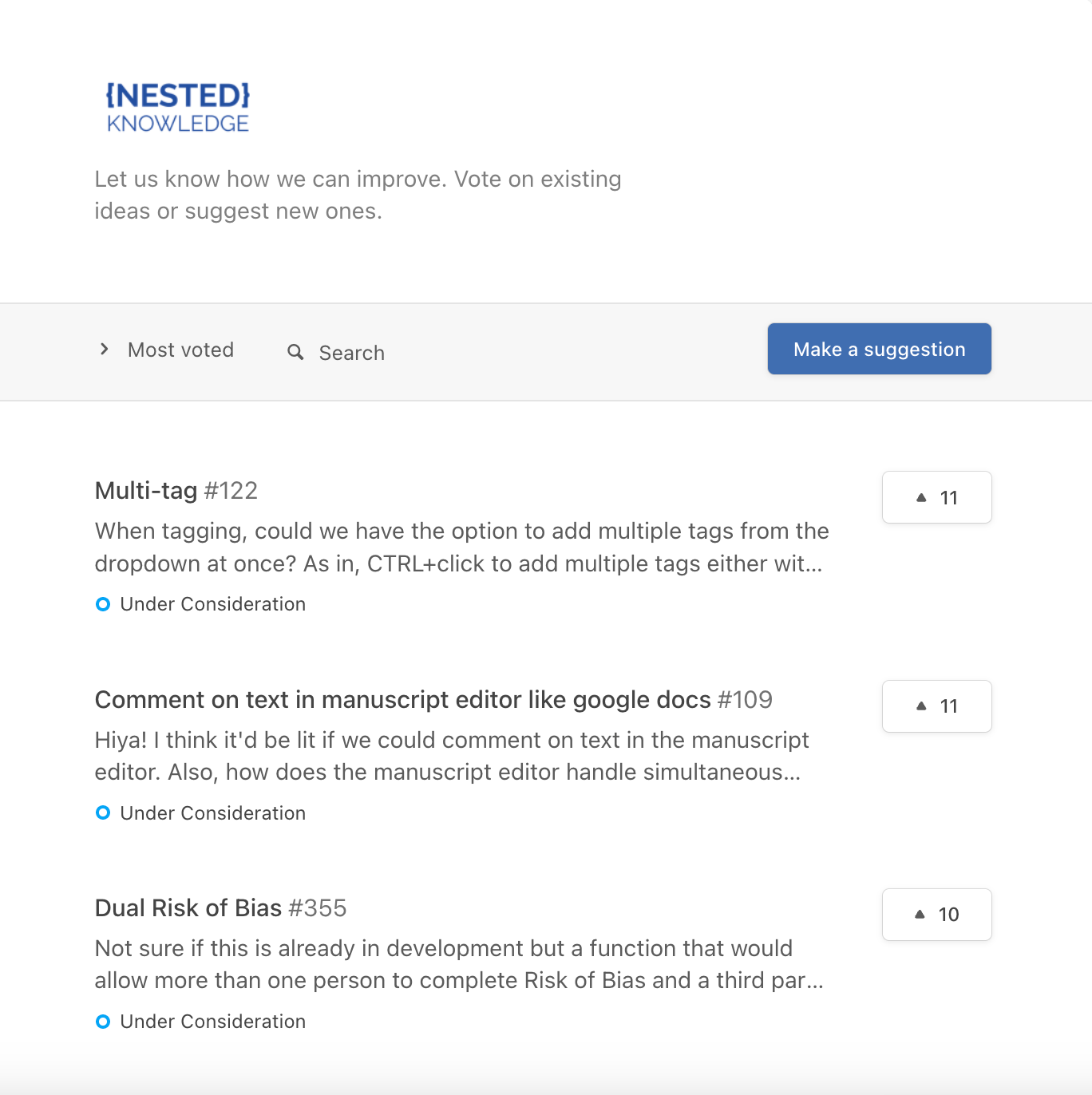
Mostly, the main board where you can see a ranking of issues by popularity. We’ve even told our customers that we’re going to prioritize the number one issue so vote for your favorite issue because that’s partially how we’re going to determine what gets built in our software.
It’s nice to have that democratization of the development process, and it allows our customers to feel like they are part of that development process. It allows them to feel closer to our product, which I really like.
If you had to sum up Nolt in one sentence, what would it be?
Lightweight user feedback.