Could you provide an overview of Komodo Deck and your background?
We launched Komodo Dots in 2019 as a hobby. It was a mobile app letting users talk over their presentations. The real breakthrough came during COVID, with universities embracing it for remote learning. Initially, we focused on education, but learned it wasn’t lucrative due to budget constraints. So, we pivoted to a productivity tool, now competing with Loom and ScreenCastify.
We offer free unlimited screen recording to users, inspired by WhatsApp's model, needing a 3-4% conversion rate to premium to cover our costs. We are the first one in the industry to do that, and we’re still trying to figure out the marketing component, building awareness, and targeting small businesses.
We’re currently at 50,000 users and targeting small businesses right now.
Komodo Deck started around 2019, and it was like a hobby. It was a Mobile app. That’s what we built first, an iOS app that lets you ingest a Powerpoint, a PDF, or a Word file and be able to record yourself talking over a document. Let’s day, you imported a 20-page PowerPoint, we would create every slide that would be an independent video where people can say ‘This is the introduction, then we are going to talk about the technology roadmap’. Imagine any sort of PowerPoint, the flexibility of recording per slide made it super easy for people who didn’t know how to edit, to record and make it a lecture or some sort of recording about their presentation. It could be anything.
There wasn’t much traction until COVID, and around 2020, when COVID hit, people started using this product, especially in universities and faculty all over the world, because everybody was learning at home, that was a new thing. So they started using Komodo to record lectures, and a lot of these lectures were uploaded Biology, Physics, Math, you name it, and all kinds of levels, all the way from kindergarten to post grad and PhD level. They started using this product to record and upload this to a content management system or learning management system they use at the university. Then, students started using it as well to submit their assignments, they would record it and upload it.
So we got an overwhelming amount of feedback and we quickly learned that the education market, as much as we love it, there isn’t a lot of money there. We finally understood that there’s discounts in education because, frankly, teachers don’t have much money to buy, if you want to sell to universities, it takes a long time. So, we pivoted and turned into a productivity tool. Now, we compete with the likes of Loom and ScreenCastify and a bunch of other screencasting softwares out there.
We are at about 50,000 users or so but I can't say we are profitable yet, like you guys. It would be slow, our burn rate is still pretty high. We have a big team, about 10 people and the engineering is a very high expense for us. We also have a very high bandwidth cost because we have hundreds of hours of video in our system every single night which adds a storage cost. The costs keep increasing because we built this company with one fundamental principle which is that the cost of storage is going down over time. If you look at cloud computing, historically the cost has been declining and so we made a proposition to our community to offer free unlimited screen recording, completely unlimited. We do this like the WhatsApp model. If you remember before WhatsApp, text messaging used to cost 10 bucks a month, which you had to pay through a carrier, and WhatsApp figured out that if they give free texting and only 1% of the user base subscribers, that can cover the entire operation. We are in a Similar boat. We need a conversion rate of about 3% to 4 % if our community to actually go up premium, and that covers all of the expenses we have in terms of running the infrastructure or everybody else. We are the first one in the industry to do that, and we’re still trying to figure out the marketing component, building awareness, and targeting small businesses
How did you come across Nolt? What problems were you dealing with or trying to solve when you first signed up?
We did an Appsumo launch about a year ago, November 2022 and the response was just overwhelming. It was pretty successful in terms of the launch, we got a lot of traffic, we had people coming in and giving us feedback, positive and negative, all the time. We don’t really have customer support. It was just me and my business partner handling all the responses, 24 hours a day. We we’re in a position where we needed to organize these requests that were coming in and we started looking at what we could buy, so Nolt was just an act of desperation. We needed something there to collect this information somehow and organize it to keep us sane.
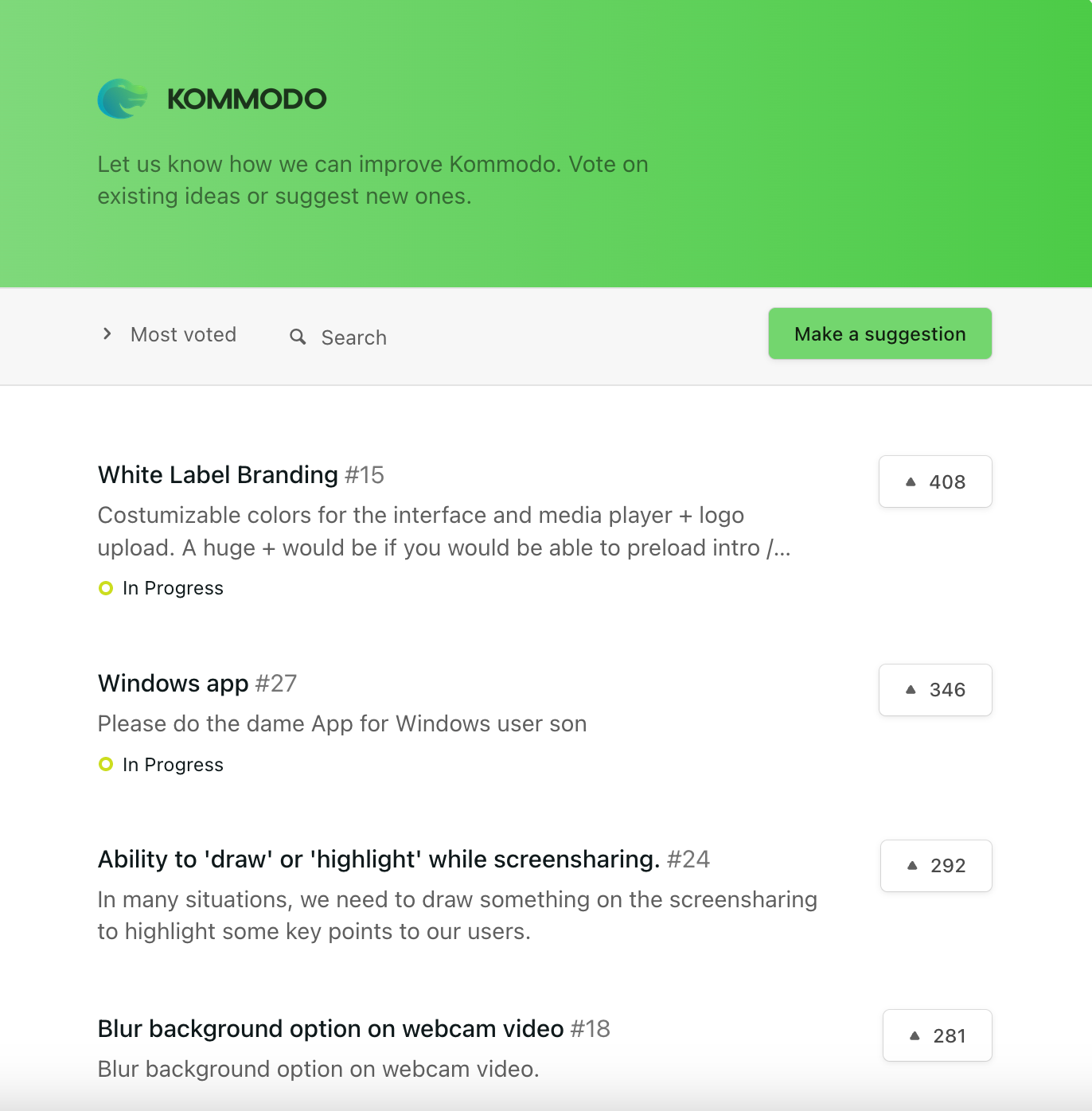
We also integrated Circle, which is a community software, because we needed a community because people were coming in, they were talking to each other and they needed a way to do this quickly. So we set up Nolt. It was literally a few hours of work, it was incredible, fast and also a simple tool. With Circle we had some bumps, it wasn’t that easy and once we set up Nolt we found people started embracing it. Now we tell our community, if you have feedback for features, go and submit them on Nolt. It doesn’t mean we are going to do all of them, but at least we have enough people to vote on them. We always look at how something is trending or how many requests something is getting to try and understand what the community wants. It really came about from the launch where we needed a space for people to come in and give us feedback because we were just going crazy. Spreadsheets weren’t working.
How does Nolt make your life and your team’s life easier on a day-to-day basis?
It provides another data point for us about what the community wants. It is useful for us, the voting part is interesting because we see the aggregation of a particular thing somebody wants and if other people vote on it, it’s a signal for us to act. We use it for product development, for roadmap planning.
You can’t make everyone happy because if you just listen to the community, your product will go in many different directions. So we have some standards and some things we want to stick to but it’s a great avenue to collect feedback and it’s frictionless really for people to post in it.
How do you combine the feedback you get from Nolt with your internal process where you have your own ideas, standards and values? Do you mesh those two approaches?
I think it’s a product development question, you probably do the same thing when you prioritize features and you might be in a similar position as us. We have an identity about Komodo Decks, It’s not meant to be a replica of Loom or a copycat of other successful companies. We think it’s a losing battle. I don’t recommend that strategy to anyone and in our space many companies are just cloning themselves as the market leader and so we took a different position. We think of ourselves as a platform company, what value added things can be built into our product to expand the possibility of screencasting software.
For example, we built SOP and guide creation, there are separate companies for that like Tango and Scribe but we built it into screen casting. So when somebody is explaining some sort of content management software, they are recording and also creating links and notes that they can take which they can edit. Other stuff we’ve done, we’re about. to launch a page builder. When somebody creates a video, people ask us ‘Can you add a call to action?’, but what they’re not saying is can they customize this page that I can sell? Of Course they’re thinking the call to action was just like a click to subscribe somewhere or get an email but we use that input to figure out what they’re looking for. Then we think about what other products we can bring to the table where we give them value that they haven’t even asked us for. It involves some guessing because people don’t tell you exactly what they want all the time. They just tell you the stuff that they’re dealing with and the frictions that they experience.
Having that identity, being a platform company and looking at other products we can build into Komodo, like a platform is against what every investor wants. If you talk to any venture capitalist, they focus on one thing or being the nest in one thing, we took that and threw it out the window. We think you have to be good at many things today because too many companies are just microscopically focused and what happens is people have to buy multiple subscriptions to multiple companies because every company is so hyper focused on what they’re doing. So having said that, when feedback comes in, we look at our thesis about who we are and what we want to be and so if a certain request meets our thesis, we will go and look at it. If it’s totally outside, if it says ‘Loom does this, can you do this too?’. We don’t act on that often because we have to tell them we are not Loom. If you want Loom, buy Loom and they will be upset with us. but we take a hard position and they respect that. They respect the clarity and where we want to go so we use it as a signal. I don't think there’s a rule on how to build products, right? It’s a subjective thing, so you just do the best you can with the data you have.
What was the setup process like?
That’s what I love the most about your tool. I didn’t do it myself, I do code but we have people that are better than me. We have a backend engineer who implemented it and we created the board, we connected a custom domain to it and linked it to ours so people can get to Nolt. It took about an hour or so, it was fast. Appsumo also has a discussion board and people started leaving reviews and feature ideas and we started pasting the link to Nolt’s board to leave feedback. We started leaving the link on Intercom as well, in the discussion groups. We started circulating it ourselves, which is pretty good for Nolt right? Because you are getting more engagement and for us it was a very fast setup process and as soon as the custom domain was working it was like you collect all the feedback here, very straightforward, very easy to do. It’s really nice when you can get a tool up and running that fast.
Since using Nolt, what benefits have you and your team gotten? What were the improvements in your workflow?
It’s a direct path we provide to our community to get feedback. The information we get from Nolt, as I said earlier, is super useful and then we act on it and also a way for us to communicate back because Nolt sends an e-mail to the folks.
The folks that are there get upset and say we’re not going to do something but at least it starts a conversation and we find that other people chime in. It’s like I’m not the only one fighting the battles, we have a community stepping up and saying certain things have to be a certain way and the dialogue is useful between us and the community.
Getting data is very useful because it gives visibility into what people are asking for.
If you have to have one sentence to describe Nolt, what would that be?
Super easy to set up and great return for the investment. It’s a very good value proposition and we’ll continue to use you guys.We’re happy it works for us and we should all have a community.