Could you provide an overview of Eequ and your background?
To start with, I kind of jumped between two different worlds. One was education, I was a teacher and a school manager very early on and then I left that world and went into technology, data science and AI. I ended up building very large softwares systems for large corporations but I was a single mom and I was still a parent. I found it so incredibly difficult to find all the things that were going on in my community and I was living in an area where there were loads of really unique, unusual small activities that were going on, forest schools and farm clubs, etc. The idea was very simple. I kinda figured that we should have a marketplace where people can come in and search what they’re looking for and they will find them, we call them the mentors.
We have a really nice management tool under the hood, both for the provider and for the learners. You can create tons of listings and you can go in and edit them and add dates, tickets, check out questions and all sorts of settings. Then you have your bookings where you can see all the information about your bookings. You also get schedules, you can see what's coming up, have waiting lists, send invoices and we’ve got tons of workflows.
The thing that is most unusual about Eequ is that it is a collaborative system where we allow different people to collaborate between different things so it acts like GitHub for teachers. Organizations can collaborate between them and still retain ownership of their listings but come under one umbrella for an event of activity.
How did you guys come to look for a solution like Nolt? Are there any issues or problems associated with you building this platform?
We’ve got quite an expert development team and we always have to make a really careful decision when we choose to use another product because we have to ask ourselves should we build it ourselves. We are always experimenting with our ideas so whenever we prioritize something, we are trying to ask ourselves, ‘Do we really need this feature?How much evidence do we have that this feature could be valuable to us?, What's the cost of it to build?’, etc. So we create a hypothesis, we think that if we made this feature, then people would use it and it would have this value to us and it was clear that it would be something that was going to take us some time to build and we had this enormous backlog of core features.
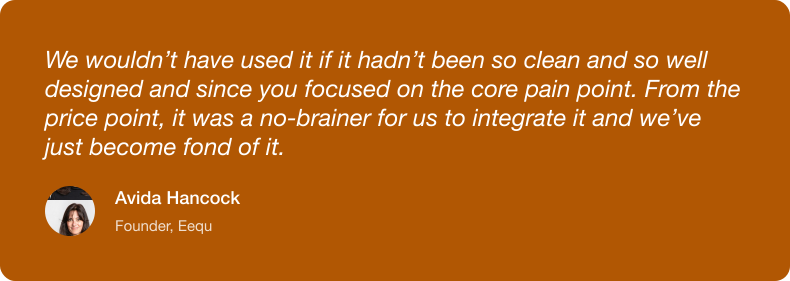
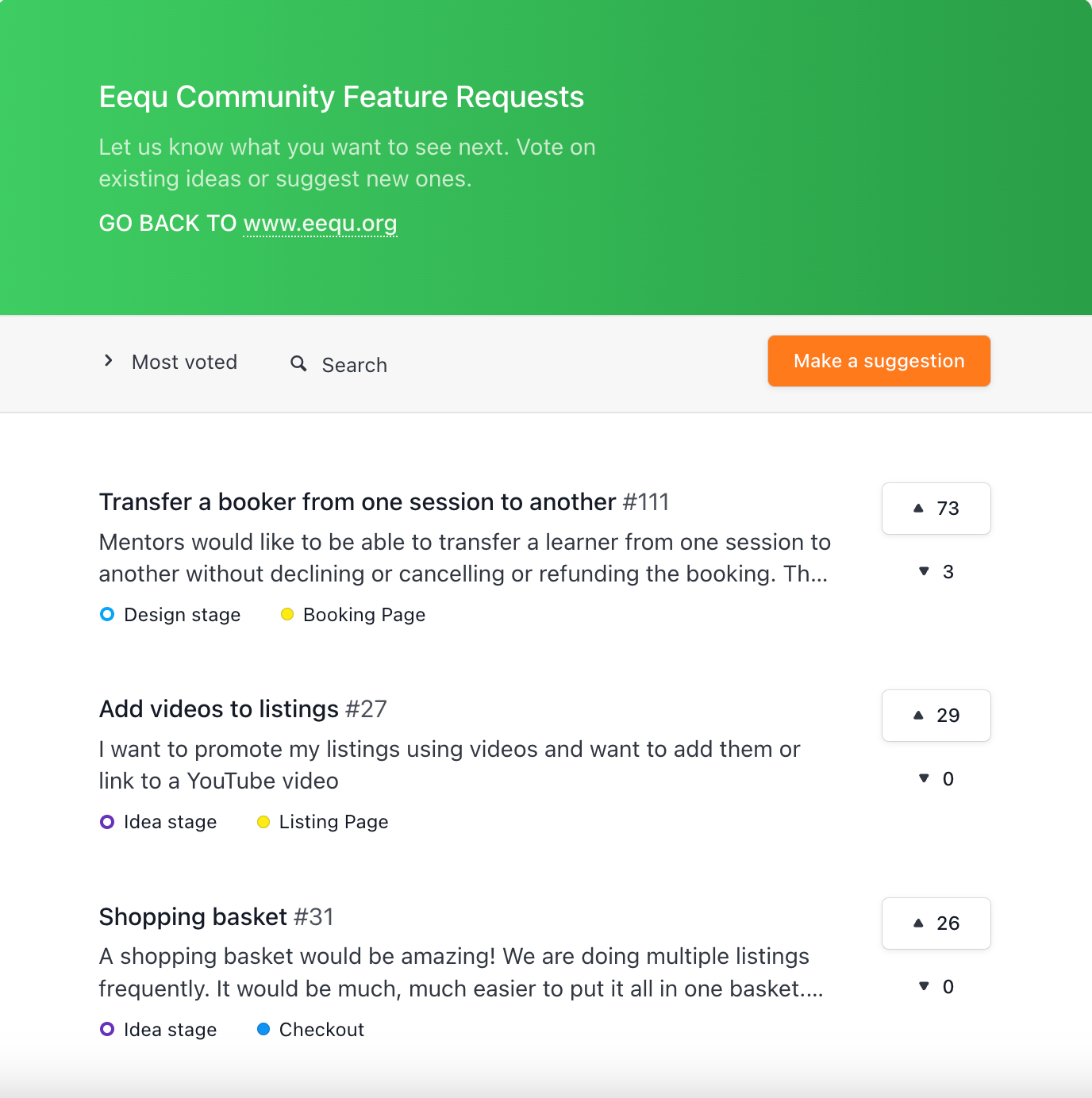
When we came across Nolt, the designs were so clean and similar to ours that we felt that it would integrate really easily into our system and there would be a smooth experience. We have it stuck in our menu, down at the bottom. We’ve got to make a feature request and report a bug. It is used quite a lot and we also use it to vote on behalf of people to try and keep an eye on what’s going on and how many people have voted for what.It’s quite difficult as you grow to really keep a rigorous check. They look really similar to Eequ and it feels really well integrated. We wouldn’t have used it if it hadn’t been so clean and so well designed and since you focused on the core pain point. From the price point, it was a no-brainer for us to integrate it and we’ve just become fond of it.
We have an integration, if someone makes a report of a bug then it will come through into our bug channel in Slack and so forth.
What are the benefits that you guys have gotten from implementing Nolt into Eequ?
The main benefit for Eequ is to let our user feel that we listen to them and that they’ve got a really clear path to be able to communicate and to see their ideas being prioritized. We haven’t got a complete buy in from our users, but it’s really nice gesture, an open gesture rather then saying e-mail us to actually say look we have thought about this, we have git a board, we are processing things and we are listening to you and we particularly like the fact that they’re notified when things move into progress and so forth.
How did you find the setup process?
It was a little bit complicated to get our domains, we did have issues and I think there was an issue on your end as well but it was easy to talk to you guys that we got it resolved in the end. We want people to be authenticated, record their name so that was another element of the set up that was important to us that was maybe a little bit tricky.
How do you use Nolt on a day-to-day basis? How often do you use it?
If I’m honest, it’s more of a customer facing tool and we are kind of waiting for you guys because we actually think that we could use it more extensively. One of the biggest problems we get, we’re always talking to customers and with bugs, we solve it straight away and in a way that more of a successful board but with feature request, we want to tell our users that their feature is in progress or that it’s being built and sometimes we forget because we have so many conversations, we forget to go back to people who’d asked for this and tell them it’s been done. There isn’t any link between your board and Intercom or your board and Linear. If we were able to connect it to a Linear ticket, that would be helpful.
If you had to describe Nolt in one sentence, what would it be?
I would say it’s a really clean customer-facing voting tool which can be used for feature requests or bug reporting. Those are the 2 core uses that I would use it for. I think it could be used for a lot more things.