Could you provide a quick overview of CloudWaitress?
CloudWaitress is a custom-branded online ordering platform for restaurants. It allows restaurants to trade directly online with their customers without paying huge commissions.
My background is in doing numerous different things in software. I started off working in software sales, selling ERP software. At the same time, I had a restaurant business with my family and ended up building an online ordering solution for the family restaurant nearly 10 years ago and the business grew out of that idea over time. That has led to what CloudWaitress has become today.
What challenges led you to look for a solution like Nolt?
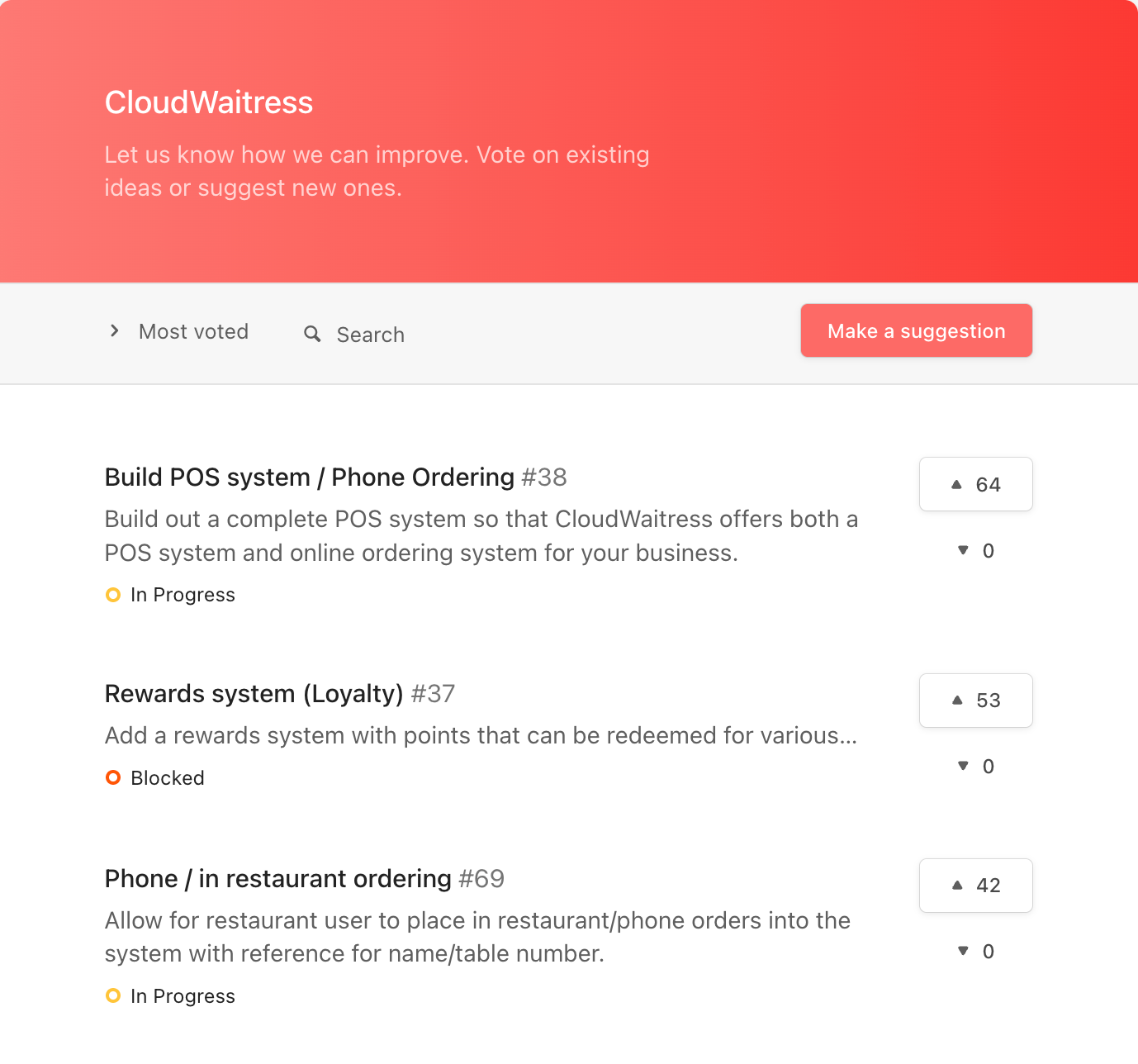
We wanted to better manage customer requests. We really wanted to be a customer-driven enterprise, and we’re about solving the problems for the customer. It’s quite difficult to do that through emails, text messages, Facebook messages, and all these other things, so having that centralized place that Nolt offers is really great.
The other challenge of having all these requests is getting feedback and prioritizing them, so the voting feature is also very useful for us as well.
Nolt just takes the hassle out of managing feature requests and helps you prioritize them. Giving updates is all automated through Nolt, too. All of these things you could, of course, do manually, but they’re just small things that you don’t realize how much time they take. All of those things add up, and Nolt just makes it simple.
How do you guys use Nolt at CloudWaitress?
Whenever there’s a feature request, we direct customers to the feedback page, which is hosted on our own domain.
We say something like: “Please take a look and vote on the things you like. If you have a suggestion, please create a post and add as much detail as possible. The benefit for you is that you’ll get updates automatically whenever we work on the feature or if we have any questions.”
The developers also browse through it and use it for filling in their workload and roadmap. We use Nolt for the roadmap for projects that we’re doing, but also for small things in between projects. They can also jump in there and pick something up and squeeze that in if they’re in between projects.
We also have it connected to Jira, which is great for creating tickets. That’s pretty slick as well. It really completes the flow for development, and it connects all the dots. That way, when the developers complete something, they know it’s from Nolt and to update everybody.
We find it completes the development cycle and tidies everything up. We found it really valuable. The only problem is that we can’t get everything done!
Which Nolt features do you use often and find important?
I think we use most of the features. The Jira integration is good for the workflow because it saves the double entry of data.
The one I personally use is just commenting on the requests and updating everyone. Getting feedback from people is useful, especially when there are 20+ votes on the feature – you can get some real feedback. We try to use the roadmap and keep it up to date. We just use it, and we drive all the requests from all the customers through Nolt, and it gives us that consolidated view. It’s a small product, but it’s a great product. We love it, and it does what you really want it to do.
How did you find the setup process for Nolt?
To be honest, I inherited it from another team member, so I don’t know. But I have sold Nolt to a couple of other people, so I know they found the setup very easy. Nolt is extremely simple to use.
Love that – a lot of our customers find that Nolt is valuable for listening to customers.
Yes, that’s what building a great product is all about. We have to solve the problems that our customers have. They’re usually right, but not always right. Most of the time, though, if you have this consensus of votes from your customer base telling you what they want, it’s generally going to be the right thing to build.
It’s also dollar productive because if you’re giving your customers what they want, they’re probably going to be more willing to pay for it, or pay a higher price for it. I just think this methodology is a no-brainer, and it’s not as common as you think.
I think Nolt can drive you to become more customer focused, and the result is that you become a more dollar productive business, you’re delivering what customers want and solving their problems. Nolt naturally drives you to do the things that are good for your business.
We’ve won deals because of showing people Nolt, especially partnerships with people who are going to sell our software. We are able to prove to them that we are customer-driven by showing them the requests, the roadmap, and the things that have been delivered. It’s really effective.
Some people might be reluctant to do this because it might reveal what they don’t have in their product, but the reality is that anybody who knows software knows there are always feature requests and bugs. If you can show that you have consistently done releases and updated a public roadmap, I think it’s really impressive and can set you apart from your competition.
If you had to sum up Nolt in one sentence, what would it be?
Nolt makes managing customer requests super easy and efficient.